How a Dental Implant Replaces a Missing Back Tooth: A Step-By-Step Guide

A detailed look into the implant process and the high-standard methodology used at KYT Dental Services.
Trust Your Teeth, created by KYT Dental Services, is where lifestyle meets dentistry — showing how daily habits shape your smile and the elevated care that protects it.
Trust Your Teeth | KYT Dental Services
Written by
Dr. Isaac Sun
Published on
November 13, 2025

Introduction: Why Back Teeth Fail First

Back molars take the full force of chewing — often over 150–200 lbs of pressure per bite.
Because of this, they’re also the teeth most likely to:

  • crack,
  • break,
  • develop deep decay,
  • fail after old fillings, or
  • collapse after years of grinding.

When a molar goes missing, the change may feel subtle at first — but the long-term consequences are significant:

  • Teeth start drifting into the empty space
  • The opposing tooth “drops” downward
  • Bite pressure shifts forward
  • Bone begins shrinking immediately
  • Chewing efficiency drops up to 40%
  • Jaw tension increases

Below is the implant sequence that mirrors the methodology and level of detail we follow at KYT Dental Services when restoring a missing tooth.
It demonstrates what modern implant dentistry looks like when performed to a high standard.

Step-By-Step Implant Sequence

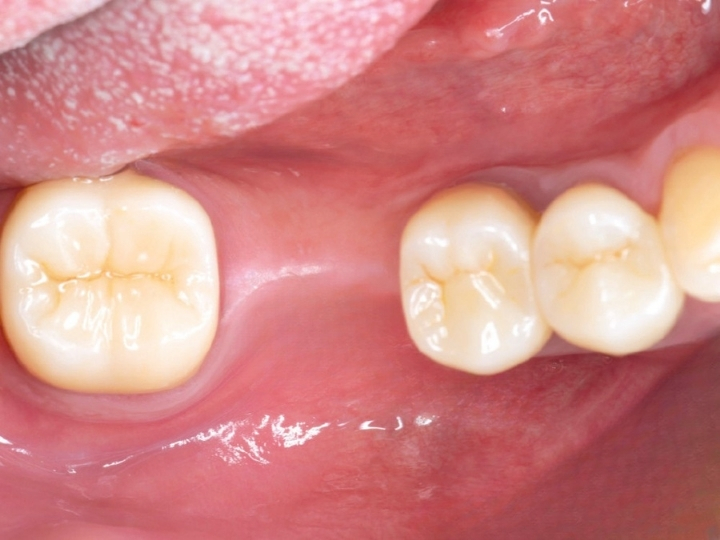
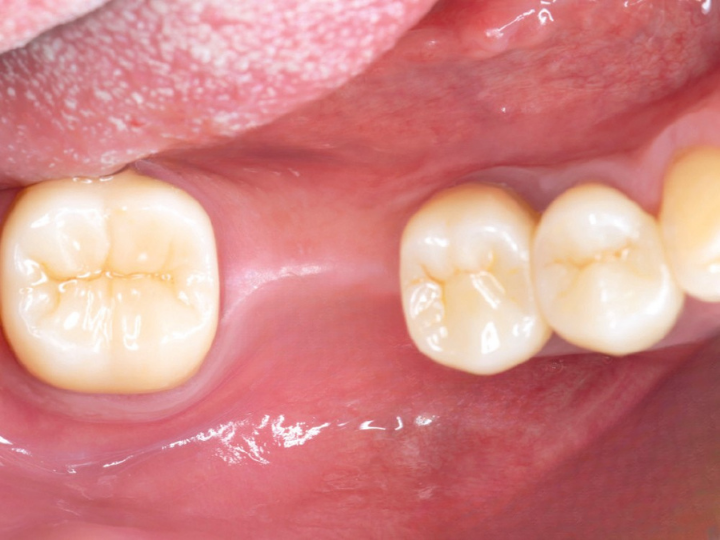
🟥 Step 1 — Missing Molar (Before Treatment)

The first image shows a healed space where a molar was previously removed.
Many patients think a missing back tooth is “not a big deal” because it doesn't show when they smile — but over time, the biological effects are significant:

  • teeth tip forward into the space
  • the upper molar drops downward
  • bone begins shrinking within months
  • chewing power on that side decreases
  • TMJ pressure increases

Restoring the missing molar prevents long-term bite collapse and bone loss.
Missing Tooth #30

🟦 Step 2 — Implant Fixture in Place (Titanium Root Installed)

In the second image, the implant fixture is already placed inside the bone.
This titanium post acts as the new “root” for the future tooth.

A properly placed implant should:

  • sit centered within healthy bone
  • have full 360° bone support
  • be angled correctly for the final crown
  • achieve strong primary stability
  • preserve bone volume long-term

This step determines the long-term success of the restoration.

HT 5.0 Implants placed using Guided Surgery Technique

🟩 Step 3 — Abutment Installed (Connector Component)

The third image shows the abutment being attached to the implant.
This is the connector piece that sits above the gumline and supports the final crown.

A precise abutment installation ensures:

  • ideal height and emergence profile
  • proper soft tissue support
  • stable connection between implant and crown
  • correct angulation for chewing forces

This stage transitions the implant from “root replacement” to “tooth replacement.”

Implant Abutment Placed To Verify Fit

🟨 Step 4 — Final Crown Delivered (Restored Tooth)

The final image shows the completed ceramic crown.
Once seated, the implant looks, feels, and functions like a natural tooth.

A well-designed implant crown:

  • restores full chewing strength
  • prevents teeth from drifting
  • stops the opposing tooth from dropping
  • protects bone from further shrinkage
  • blends seamlessly with natural enamel

When done correctly, the implant integrates fully with the bite and becomes a long-term functional tooth.

Implant Crown Placed over Abutment

🌟 Why Dental Implants Are the Best Option for Missing Molars

✔ Prevent bone loss

The implant stimulates bone like a natural root.

✔ Restore chewing power

Far stronger than bridges or removable partials.

✔ Do not damage adjacent teeth

No grinding down healthy enamel.

✔ Long lifespan

Often 20–30+ years with proper care.

✔ PPO-friendly

Most PPO plans cover the abutment + crown.

❓ People Also Ask

Do you need to replace a missing molar?

Yes — it prevents bone loss, shifting teeth, and bite collapse.

How long do dental implants last?

20–30+ years in most healthy patients.

Are dental implants painful?

Most patients describe the experience as easier than an extraction.

How long is the implant process?

Typically 3–6 months from placement to crown.

🧾 FAQ Section

1. How soon should I replace a missing back tooth?

Ideally within 3–6 months to prevent bone and bite changes.

2. Is an implant better than a bridge?

Yes — implants preserve bone and don’t require drilling healthy teeth.

3. Can the implant crown match my natural teeth?

Yes. Modern ceramics blend in extremely well.

4. Are implants safe for everyone?

Most adults qualify; a CBCT scan determines bone health.

5. What is the downtime after implant placement?

Most patients return to normal activities within 24 hours.

6. Does a dental implant feel like a real tooth?

Yes — once restored, it feels natural when chewing and biting.

7. Does PPO insurance help cover implants?

Most PPO plans cover the abutment and crown, with some contributing toward the implant fixture.

PPO patients receive full coverage for an exam and 3D scan at KYT Dental Services in Fountain Valley.
See whether a dental implant is the right choice for restoring your bite and long-term health.
Schedule your appointment today.


Keep Your Teeth
Premium dental care that goes beyond patchwork. At KYT Dental Services, every visit is designed to protect your smile for life — seamless, premium, and reassuring.
Thank you! Your submission has been received!
Oops! Something went wrong while submitting the form.
Dr. Isaac Sun
👤 About the Author
Dr. Isaac Sun, DDS, is the founder of KYT Dental Services in Fountain Valley, CA. As both a practicing dentist and visionary leader, he is committed to redefining patient care by combining concierge-level dentistry with an innovative approach to scaling premium dental services. His mission is to deliver lasting results and elevate the standard of care for every smile, while building a model that grows with the evolving needs of the community.

Book Your PPO Dental Visit at KYT Dental Services Today

Awareness is the first step, action is the second. If you’re covered by PPO dental insurance, you already have access to the preventive and restorative care that keeps small issues from becoming big concerns.

At KYT Dental Services, we believe your dental visits should feel like part of your lifestyle—seamless, premium, and reassuring.

Because your daily rituals should be enjoyable, not quietly costly.
Thank you! Your submission has been received!
Oops! Something went wrong while submitting the form.
Feature imageFeature imageFeature imageFeature imageFeature image